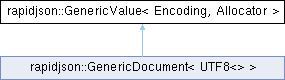
Represents a JSON value. Use Value for UTF8 encoding and default allocator. More...
#include <document.h>
Public Types | |
| typedef GenericMember< Encoding, Allocator > | Member |
| Name-value pair in an object. | |
| typedef Encoding | EncodingType |
| Encoding type from template parameter. | |
| typedef Allocator | AllocatorType |
| Allocator type from template parameter. | |
| typedef Encoding::Ch | Ch |
| Character type derived from Encoding. | |
| typedef GenericStringRef< Ch > | StringRefType |
| Reference to a constant string. | |
| typedef GenericMemberIterator< false, Encoding, Allocator >::Iterator | MemberIterator |
| Member iterator for iterating in object. | |
| typedef GenericMemberIterator< true, Encoding, Allocator >::Iterator | ConstMemberIterator |
| Constant member iterator for iterating in object. | |
| typedef GenericValue * | ValueIterator |
| Value iterator for iterating in array. | |
| typedef const GenericValue * | ConstValueIterator |
| Constant value iterator for iterating in array. | |
| typedef GenericValue< Encoding, Allocator > | ValueType |
| Value type of itself. | |
| typedef GenericArray< false, ValueType > | Array |
| typedef GenericArray< true, ValueType > | ConstArray |
| typedef GenericObject< false, ValueType > | Object |
| typedef GenericObject< true, ValueType > | ConstObject |
Public Member Functions | |
Type | |
| Type | GetType () const |
| bool | IsNull () const |
| bool | IsFalse () const |
| bool | IsTrue () const |
| bool | IsBool () const |
| bool | IsObject () const |
| bool | IsArray () const |
| bool | IsNumber () const |
| bool | IsInt () const |
| bool | IsUint () const |
| bool | IsInt64 () const |
| bool | IsUint64 () const |
| bool | IsDouble () const |
| bool | IsString () const |
| bool | IsLosslessDouble () const |
| bool | IsFloat () const |
| bool | IsLosslessFloat () const |
Null | |
| GenericValue & | SetNull () |
Bool | |
| bool | GetBool () const |
| Set boolean value. | |
| GenericValue & | SetBool (bool b) |
Object | |
| GenericValue & | SetObject () |
| Set this value as an empty object. | |
| SizeType | MemberCount () const |
| Get the number of members in the object. | |
| bool | ObjectEmpty () const |
| Check whether the object is empty. | |
| template<typename T> | |
| GenericValue & | operator[] (T *name) |
| Get a value from an object associated with the name. | |
| template<typename T> | |
| const GenericValue & | operator[] (T *name) const |
| template<typename SourceAllocator> | |
| GenericValue & | operator[] (const GenericValue< Encoding, SourceAllocator > &name) |
| Get a value from an object associated with the name. | |
| template<typename SourceAllocator> | |
| const GenericValue & | operator[] (const GenericValue< Encoding, SourceAllocator > &name) const |
| ConstMemberIterator | MemberBegin () const |
| Const member iterator. | |
| ConstMemberIterator | MemberEnd () const |
| Const past-the-end member iterator. | |
| MemberIterator | MemberBegin () |
| Member iterator. | |
| MemberIterator | MemberEnd () |
| Past-the-end member iterator | |
| bool | HasMember (const Ch *name) const |
| Check whether a member exists in the object. | |
| template<typename SourceAllocator> | |
| bool | HasMember (const GenericValue< Encoding, SourceAllocator > &name) const |
| Check whether a member exists in the object with GenericValue name. | |
| MemberIterator | FindMember (const Ch *name) |
| Find member by name. | |
| ConstMemberIterator | FindMember (const Ch *name) const |
| template<typename SourceAllocator> | |
| MemberIterator | FindMember (const GenericValue< Encoding, SourceAllocator > &name) |
| Find member by name. | |
| template<typename SourceAllocator> | |
| ConstMemberIterator | FindMember (const GenericValue< Encoding, SourceAllocator > &name) const |
| GenericValue & | AddMember (GenericValue &name, GenericValue &value, Allocator &allocator) |
| Add a member (name-value pair) to the object. | |
| GenericValue & | AddMember (GenericValue &name, StringRefType value, Allocator &allocator) |
| Add a constant string value as member (name-value pair) to the object. | |
| template<typename T> | |
| GenericValue & | AddMember (GenericValue &name, T value, Allocator &allocator) |
| Add any primitive value as member (name-value pair) to the object. | |
| GenericValue & | AddMember (StringRefType name, GenericValue &value, Allocator &allocator) |
| Add a member (name-value pair) to the object. | |
| GenericValue & | AddMember (StringRefType name, StringRefType value, Allocator &allocator) |
| Add a constant string value as member (name-value pair) to the object. | |
| template<typename T> | |
| GenericValue & | AddMember (StringRefType name, T value, Allocator &allocator) |
| Add any primitive value as member (name-value pair) to the object. | |
| void | RemoveAllMembers () |
| Remove all members in the object. | |
| bool | RemoveMember (const Ch *name) |
| Remove a member in object by its name. | |
| template<typename SourceAllocator> | |
| bool | RemoveMember (const GenericValue< Encoding, SourceAllocator > &name) |
| MemberIterator | RemoveMember (MemberIterator m) |
| Remove a member in object by iterator. | |
| MemberIterator | EraseMember (ConstMemberIterator pos) |
| Remove a member from an object by iterator. | |
| MemberIterator | EraseMember (ConstMemberIterator first, ConstMemberIterator last) |
| Remove members in the range [first, last) from an object. | |
| bool | EraseMember (const Ch *name) |
| Erase a member in object by its name. | |
| template<typename SourceAllocator> | |
| bool | EraseMember (const GenericValue< Encoding, SourceAllocator > &name) |
| Object | GetObject () |
| ConstObject | GetObject () const |
Number | |
| int | GetInt () const |
| unsigned | GetUint () const |
| int64_t | GetInt64 () const |
| uint64_t | GetUint64 () const |
| double | GetDouble () const |
| Get the value as double type. | |
| float | GetFloat () const |
| Get the value as float type. | |
| GenericValue & | SetInt (int i) |
| GenericValue & | SetUint (unsigned u) |
| GenericValue & | SetInt64 (int64_t i64) |
| GenericValue & | SetUint64 (uint64_t u64) |
| GenericValue & | SetDouble (double d) |
| GenericValue & | SetFloat (float f) |
String | |
| const Ch * | GetString () const |
| SizeType | GetStringLength () const |
| Get the length of string. | |
| GenericValue & | SetString (const Ch *s, SizeType length) |
| Set this value as a string without copying source string. | |
| GenericValue & | SetString (StringRefType s) |
| Set this value as a string without copying source string. | |
| GenericValue & | SetString (const Ch *s, SizeType length, Allocator &allocator) |
| Set this value as a string by copying from source string. | |
| GenericValue & | SetString (const Ch *s, Allocator &allocator) |
| Set this value as a string by copying from source string. | |
Array | |
| template<typename, typename, typename> | |
| class | GenericDocument |
| GenericValue & | SetArray () |
| Set this value as an empty array. | |
| SizeType | Size () const |
| Get the number of elements in array. | |
| SizeType | Capacity () const |
| Get the capacity of array. | |
| bool | Empty () const |
| Check whether the array is empty. | |
| void | Clear () |
| Remove all elements in the array. | |
| GenericValue & | operator[] (SizeType index) |
| Get an element from array by index. | |
| const GenericValue & | operator[] (SizeType index) const |
| ValueIterator | Begin () |
| Element iterator. | |
| ValueIterator | End () |
| Past-the-end element iterator | |
| ConstValueIterator | Begin () const |
| Constant element iterator. | |
| ConstValueIterator | End () const |
| Constant past-the-end element iterator. | |
| GenericValue & | Reserve (SizeType newCapacity, Allocator &allocator) |
| Request the array to have enough capacity to store elements. | |
| GenericValue & | PushBack (GenericValue &value, Allocator &allocator) |
| Append a GenericValue at the end of the array. | |
| GenericValue & | PushBack (StringRefType value, Allocator &allocator) |
| Append a constant string reference at the end of the array. | |
| template<typename T> | |
| GenericValue & | PushBack (T value, Allocator &allocator) |
| Append a primitive value at the end of the array. | |
| GenericValue & | PopBack () |
| Remove the last element in the array. | |
| ValueIterator | Erase (ConstValueIterator pos) |
| Remove an element of array by iterator. | |
| ValueIterator | Erase (ConstValueIterator first, ConstValueIterator last) |
| Remove elements in the range [first, last) of the array. | |
| Array | GetArray () |
| ConstArray | GetArray () const |
| template<typename T> | |
| bool | Is () const |
| Templated version for checking whether this value is type T. | |
| template<typename T> | |
| T | Get () const |
| template<typename T> | |
| T | Get () |
| template<typename T> | |
| ValueType & | Set (const T &data) |
| template<typename T> | |
| ValueType & | Set (const T &data, AllocatorType &allocator) |
| template<typename Handler> | |
| bool | Accept (Handler &handler) const |
| Generate events of this value to a Handler. | |
Assignment operators | |
| void | swap (GenericValue &a, GenericValue &b) RAPIDJSON_NOEXCEPT |
| free-standing swap function helper | |
| GenericValue & | operator= (GenericValue &rhs) RAPIDJSON_NOEXCEPT |
| Assignment with move semantics. | |
| GenericValue & | operator= (StringRefType str) RAPIDJSON_NOEXCEPT |
| Assignment of constant string reference (no copy). | |
| template<typename T> | |
| GenericValue & | operator= (T value) |
| Assignment with primitive types. | |
| template<typename SourceAllocator> | |
| GenericValue & | CopyFrom (const GenericValue< Encoding, SourceAllocator > &rhs, Allocator &allocator) |
| Deep-copy assignment from Value. | |
| GenericValue & | Swap (GenericValue &other) RAPIDJSON_NOEXCEPT |
| Exchange the contents of this value with those of other. | |
| GenericValue & | Move () RAPIDJSON_NOEXCEPT |
| Prepare Value for move semantics. | |
Equal-to and not-equal-to operators | |
| template<typename T> | |
| bool | operator== (const T &lhs, const GenericValue &rhs) |
| Equal-to operator with arbitrary types (symmetric version). | |
| template<typename T> | |
| bool | operator!= (const T &lhs, const GenericValue &rhs) |
| Not-Equal-to operator with arbitrary types (symmetric version). | |
| template<typename SourceAllocator> | |
| bool | operator== (const GenericValue< Encoding, SourceAllocator > &rhs) const |
| Equal-to operator. | |
| bool | operator== (const Ch *rhs) const |
| Equal-to operator with const C-string pointer. | |
| template<typename T> | |
| bool | operator== (const T &rhs) const |
| Equal-to operator with primitive types. | |
| template<typename SourceAllocator> | |
| bool | operator!= (const GenericValue< Encoding, SourceAllocator > &rhs) const |
| Not-equal-to operator. | |
| bool | operator!= (const Ch *rhs) const |
| Not-equal-to operator with const C-string pointer. | |
| template<typename T> | |
| bool | operator!= (const T &rhs) const |
| Not-equal-to operator with arbitrary types. | |
Constructors and destructor. | |
| GenericValue () RAPIDJSON_NOEXCEPT | |
| Default constructor creates a null value. | |
| GenericValue (Type type) RAPIDJSON_NOEXCEPT | |
| Constructor with JSON value type. | |
| template<typename SourceAllocator> | |
| GenericValue (const GenericValue< Encoding, SourceAllocator > &rhs, Allocator &allocator) | |
| Explicit copy constructor (with allocator). | |
| GenericValue (bool b) RAPIDJSON_NOEXCEPT | |
| Constructor for boolean value. | |
| GenericValue (int i) RAPIDJSON_NOEXCEPT | |
| Constructor for int value. | |
| GenericValue (unsigned u) RAPIDJSON_NOEXCEPT | |
| Constructor for unsigned value. | |
| GenericValue (int64_t i64) RAPIDJSON_NOEXCEPT | |
| Constructor for int64_t value. | |
| GenericValue (uint64_t u64) RAPIDJSON_NOEXCEPT | |
| Constructor for uint64_t value. | |
| GenericValue (double d) RAPIDJSON_NOEXCEPT | |
| Constructor for double value. | |
| GenericValue (const Ch *s, SizeType length) RAPIDJSON_NOEXCEPT | |
| Constructor for constant string (i.e. do not make a copy of string). | |
| GenericValue (StringRefType s) RAPIDJSON_NOEXCEPT | |
| Constructor for constant string (i.e. do not make a copy of string). | |
| GenericValue (const Ch *s, SizeType length, Allocator &allocator) | |
| Constructor for copy-string (i.e. do make a copy of string). | |
| GenericValue (const Ch *s, Allocator &allocator) | |
| Constructor for copy-string (i.e. do make a copy of string). | |
| GenericValue (Array a) RAPIDJSON_NOEXCEPT | |
| Constructor for Array. | |
| GenericValue (Object o) RAPIDJSON_NOEXCEPT | |
| Constructor for Object. | |
| ~GenericValue () | |
| Destructor. | |
Detailed Description
class rapidjson::GenericValue< Encoding, Allocator >
Represents a JSON value. Use Value for UTF8 encoding and default allocator.
A JSON value can be one of 7 types. This class is a variant type supporting these types.
Constructor & Destructor Documentation
◆ GenericValue() [1/5]
|
inlineexplicit |
◆ GenericValue() [2/5]
|
inline |
Explicit copy constructor (with allocator).
Creates a copy of a Value by using the given Allocator
- Template Parameters
-
SourceAllocator allocator of rhs
- Parameters
-
rhs Value to copy from (read-only) allocator Allocator for allocating copied elements and buffers. Commonly use GenericDocument::GetAllocator().
- See also
- CopyFrom()
◆ GenericValue() [3/5]
|
inlineexplicit |
Constructor for boolean value.
- Parameters
-
b Boolean value
- Note
- This constructor is limited to real boolean values and rejects implicitly converted types like arbitrary pointers. Use an explicit cast to
bool, if you want to construct a boolean JSON value in such cases.
◆ GenericValue() [4/5]
|
inline |
Constructor for Array.
- Parameters
-
a An array obtained by GetArray().
- Note
Arrayis always pass-by-value.- the source array is moved into this value and the sourec array becomes empty.
◆ GenericValue() [5/5]
|
inline |
Constructor for Object.
- Parameters
-
o An object obtained by GetObject().
- Note
Objectis always pass-by-value.- the source object is moved into this value and the sourec object becomes empty.
◆ ~GenericValue()
|
inline |
Destructor.
Need to destruct elements of array, members of object, or copy-string.
Member Function Documentation
◆ Accept()
|
inline |
Generate events of this value to a Handler.
This function adopts the GoF visitor pattern. Typical usage is to output this JSON value as JSON text via Writer, which is a Handler. It can also be used to deep clone this value via GenericDocument, which is also a Handler.
- Template Parameters
-
Handler type of handler.
- Parameters
-
handler An object implementing concept Handler.
◆ AddMember() [1/6]
|
inline |
Add a member (name-value pair) to the object.
- Parameters
-
name A string value as name of member. value Value of any type. allocator Allocator for reallocating memory. It must be the same one as used before. Commonly use GenericDocument::GetAllocator().
- Returns
- The value itself for fluent API.
- Note
- The ownership of
nameandvaluewill be transferred to this object on success.
- Precondition
- IsObject() && name.IsString()
- Postcondition
- name.IsNull() && value.IsNull()
- Note
- Amortized Constant time complexity.
◆ AddMember() [2/6]
|
inline |
Add a constant string value as member (name-value pair) to the object.
- Parameters
-
name A string value as name of member. value constant string reference as value of member. allocator Allocator for reallocating memory. It must be the same one as used before. Commonly use GenericDocument::GetAllocator().
- Returns
- The value itself for fluent API.
- Precondition
- IsObject()
- Note
- This overload is needed to avoid clashes with the generic primitive type AddMember(GenericValue&,T,Allocator&) overload below.
- Amortized Constant time complexity.
◆ AddMember() [3/6]
|
inline |
Add any primitive value as member (name-value pair) to the object.
- Template Parameters
-
T Either Type, int,unsigned,int64_t,uint64_t
- Parameters
-
name A string value as name of member. value Value of primitive type Tas value of memberallocator Allocator for reallocating memory. Commonly use GenericDocument::GetAllocator().
- Returns
- The value itself for fluent API.
- Precondition
- IsObject()
- Note
- The source type
Texplicitly disallows all pointer types, especially (const) Ch*. This helps avoiding implicitly referencing character strings with insufficient lifetime, use AddMember(StringRefType, GenericValue&, Allocator&) or AddMember(StringRefType, StringRefType, Allocator&). All other pointer types would implicitly convert tobool, use an explicit cast instead, if needed. - Amortized Constant time complexity.
◆ AddMember() [4/6]
|
inline |
Add a member (name-value pair) to the object.
- Parameters
-
name A constant string reference as name of member. value Value of any type. allocator Allocator for reallocating memory. It must be the same one as used before. Commonly use GenericDocument::GetAllocator().
- Returns
- The value itself for fluent API.
- Note
- The ownership of
valuewill be transferred to this object on success.
- Precondition
- IsObject()
- Postcondition
- value.IsNull()
- Note
- Amortized Constant time complexity.
◆ AddMember() [5/6]
|
inline |
Add a constant string value as member (name-value pair) to the object.
- Parameters
-
name A constant string reference as name of member. value constant string reference as value of member. allocator Allocator for reallocating memory. It must be the same one as used before. Commonly use GenericDocument::GetAllocator().
- Returns
- The value itself for fluent API.
- Precondition
- IsObject()
- Note
- This overload is needed to avoid clashes with the generic primitive type AddMember(StringRefType,T,Allocator&) overload below.
- Amortized Constant time complexity.
◆ AddMember() [6/6]
|
inline |
Add any primitive value as member (name-value pair) to the object.
- Template Parameters
-
T Either Type, int,unsigned,int64_t,uint64_t
- Parameters
-
name A constant string reference as name of member. value Value of primitive type Tas value of memberallocator Allocator for reallocating memory. Commonly use GenericDocument::GetAllocator().
- Returns
- The value itself for fluent API.
- Precondition
- IsObject()
- Note
- The source type
Texplicitly disallows all pointer types, especially (const) Ch*. This helps avoiding implicitly referencing character strings with insufficient lifetime, use AddMember(StringRefType, GenericValue&, Allocator&) or AddMember(StringRefType, StringRefType, Allocator&). All other pointer types would implicitly convert tobool, use an explicit cast instead, if needed. - Amortized Constant time complexity.
◆ Begin() [1/2]
|
inline |
Element iterator.
- Precondition
- IsArray() == true
◆ Begin() [2/2]
|
inline |
Constant element iterator.
- Precondition
- IsArray() == true
◆ Clear()
|
inline |
Remove all elements in the array.
This function do not deallocate memory in the array, i.e. the capacity is unchanged.
- Note
- Linear time complexity.
◆ CopyFrom()
|
inline |
◆ End() [1/2]
|
inline |
Past-the-end element iterator
- Precondition
- IsArray() == true
◆ End() [2/2]
|
inline |
Constant past-the-end element iterator.
- Precondition
- IsArray() == true
◆ Erase() [1/2]
|
inline |
Remove elements in the range [first, last) of the array.
- Parameters
-
first iterator to the first element to remove last iterator following the last element to remove
- Returns
- Iterator following the last removed element.
- Note
- Linear time complexity.
◆ Erase() [2/2]
|
inline |
◆ EraseMember() [1/3]
|
inline |
Erase a member in object by its name.
- Parameters
-
name Name of member to be removed.
- Returns
- Whether the member existed.
- Note
- Linear time complexity.
◆ EraseMember() [2/3]
|
inline |
Remove members in the range [first, last) from an object.
- Parameters
-
first iterator to the first member to remove last iterator following the last member to remove
- Precondition
- IsObject() == true && MemberBegin() <=
first<=last<= MemberEnd()
- Returns
- Iterator following the last removed element.
- Note
- This function preserves the relative order of the remaining object members.
- Linear time complexity.
◆ EraseMember() [3/3]
|
inline |
Remove a member from an object by iterator.
- Parameters
-
pos iterator to the member to remove
- Precondition
- IsObject() == true && MemberBegin() <=
pos< MemberEnd()
- Returns
- Iterator following the removed element. If the iterator
posrefers to the last element, the MemberEnd() iterator is returned.
- Note
- This function preserves the relative order of the remaining object members. If you do not need this, use the more efficient RemoveMember(MemberIterator).
- Linear time complexity.
◆ FindMember() [1/2]
|
inline |
Find member by name.
- Parameters
-
name Member name to be searched.
- Precondition
- IsObject() == true
- Returns
- Iterator to member, if it exists. Otherwise returns MemberEnd().
- Note
- Earlier versions of Rapidjson returned a
NULLpointer, in case the requested member doesn't exist. For consistency with e.g.std::map, this has been changed to MemberEnd() now. - Linear time complexity.
◆ FindMember() [2/2]
|
inline |
Find member by name.
This version is faster because it does not need a StrLen(). It can also handle string with null character.
- Parameters
-
name Member name to be searched.
- Precondition
- IsObject() == true
- Returns
- Iterator to member, if it exists. Otherwise returns MemberEnd().
- Note
- Earlier versions of Rapidjson returned a
NULLpointer, in case the requested member doesn't exist. For consistency with e.g.std::map, this has been changed to MemberEnd() now. - Linear time complexity.
◆ GetDouble()
|
inline |
Get the value as double type.
- Note
- If the value is 64-bit integer type, it may lose precision. Use
IsLosslessDouble()to check whether the converison is lossless.
◆ GetFloat()
|
inline |
Get the value as float type.
- Note
- If the value is 64-bit integer type, it may lose precision. Use
IsLosslessFloat()to check whether the converison is lossless.
◆ GetStringLength()
|
inline |
Get the length of string.
Since rapidjson permits "\\u0000" in the json string, strlen(v.GetString()) may not equal to v.GetStringLength().
◆ HasMember() [1/2]
|
inline |
Check whether a member exists in the object.
- Parameters
-
name Member name to be searched.
- Precondition
- IsObject() == true
- Returns
- Whether a member with that name exists.
- Note
- It is better to use FindMember() directly if you need the obtain the value as well.
- Linear time complexity.
◆ HasMember() [2/2]
|
inline |
Check whether a member exists in the object with GenericValue name.
This version is faster because it does not need a StrLen(). It can also handle string with null character.
- Parameters
-
name Member name to be searched.
- Precondition
- IsObject() == true
- Returns
- Whether a member with that name exists.
- Note
- It is better to use FindMember() directly if you need the obtain the value as well.
- Linear time complexity.
◆ Is()
|
inline |
Templated version for checking whether this value is type T.
- Template Parameters
-
T Either bool,int,unsigned,int64_t,uint64_t,double,float,constchar*,std::basic_string<Ch>
◆ MemberBegin() [1/2]
|
inline |
Member iterator.
- Precondition
- IsObject() == true
◆ MemberBegin() [2/2]
|
inline |
Const member iterator.
- Precondition
- IsObject() == true
◆ MemberEnd() [1/2]
|
inline |
Past-the-end member iterator
- Precondition
- IsObject() == true
◆ MemberEnd() [2/2]
|
inline |
Const past-the-end member iterator.
- Precondition
- IsObject() == true
◆ Move()
|
inline |
Prepare Value for move semantics.
- Returns
- *this
◆ operator!=() [1/2]
|
inline |
Not-equal-to operator.
- Returns
- !(*this == rhs)
◆ operator!=() [2/2]
|
inline |
Not-equal-to operator with arbitrary types.
- Returns
- !(*this == rhs)
◆ operator=() [1/3]
|
inline |
Assignment with move semantics.
- Parameters
-
rhs Source of the assignment. It will become a null value after assignment.
◆ operator=() [2/3]
|
inline |
Assignment of constant string reference (no copy).
- Parameters
-
str Constant string reference to be assigned
- Note
- This overload is needed to avoid clashes with the generic primitive type assignment overload below.
- See also
- GenericStringRef, operator=(T)
◆ operator=() [3/3]
|
inline |
Assignment with primitive types.
- Template Parameters
-
T Either Type, int,unsigned,int64_t,uint64_t
- Parameters
-
value The value to be assigned.
- Note
- The source type
Texplicitly disallows all pointer types, especially (const) Ch*. This helps avoiding implicitly referencing character strings with insufficient lifetime, use SetString(const Ch*, Allocator&) (for copying) or StringRef() (to explicitly mark the pointer as constant) instead. All other pointer types would implicitly convert tobool, use SetBool() instead.
◆ operator==() [1/2]
|
inline |
Equal-to operator.
- Note
- If an object contains duplicated named member, comparing equality with any object is always
false. - Linear time complexity (number of all values in the subtree and total lengths of all strings).
◆ operator==() [2/2]
|
inline |
Equal-to operator with primitive types.
- Template Parameters
-
T Either Type, int,unsigned,int64_t,uint64_t,double,true,false
◆ operator[]() [1/3]
|
inline |
Get a value from an object associated with the name.
- Precondition
- IsObject() == true
- Template Parameters
-
SourceAllocator Allocator of the namevalue
- Note
- Compared to operator[](T*), this version is faster because it does not need a StrLen(). And it can also handle strings with embedded null characters.
- Linear time complexity.
◆ operator[]() [2/3]
|
inline |
Get an element from array by index.
- Precondition
- IsArray() == true
- Parameters
-
index Zero-based index of element.
- See also
- operator[](T*)
◆ operator[]() [3/3]
|
inline |
Get a value from an object associated with the name.
- Precondition
- IsObject() == true
- Template Parameters
-
T Either ChorconstCh(template used for disambiguation with operator[](SizeType))
- Note
- In version 0.1x, if the member is not found, this function returns a null value. This makes issue 7. Since 0.2, if the name is not correct, it will assert. If user is unsure whether a member exists, user should use HasMember() first. A better approach is to use FindMember().
- Linear time complexity.
◆ PopBack()
|
inline |
Remove the last element in the array.
- Note
- Constant time complexity.
◆ PushBack() [1/3]
|
inline |
Append a GenericValue at the end of the array.
- Parameters
-
value Value to be appended. allocator Allocator for reallocating memory. It must be the same one as used before. Commonly use GenericDocument::GetAllocator().
- Precondition
- IsArray() == true
- Postcondition
- value.IsNull() == true
- Returns
- The value itself for fluent API.
- Note
- The ownership of
valuewill be transferred to this array on success. - If the number of elements to be appended is known, calls Reserve() once first may be more efficient.
- Amortized constant time complexity.
◆ PushBack() [2/3]
|
inline |
Append a constant string reference at the end of the array.
- Parameters
-
value Constant string reference to be appended. allocator Allocator for reallocating memory. It must be the same one used previously. Commonly use GenericDocument::GetAllocator().
- Precondition
- IsArray() == true
- Returns
- The value itself for fluent API.
- Note
- If the number of elements to be appended is known, calls Reserve() once first may be more efficient.
- Amortized constant time complexity.
- See also
- GenericStringRef
◆ PushBack() [3/3]
|
inline |
Append a primitive value at the end of the array.
- Template Parameters
-
T Either Type, int,unsigned,int64_t,uint64_t
- Parameters
-
value Value of primitive type T to be appended. allocator Allocator for reallocating memory. It must be the same one as used before. Commonly use GenericDocument::GetAllocator().
- Precondition
- IsArray() == true
- Returns
- The value itself for fluent API.
- Note
- If the number of elements to be appended is known, calls Reserve() once first may be more efficient.
-
The source type
Texplicitly disallows all pointer types, especially (const) Ch*. This helps avoiding implicitly referencing character strings with insufficient lifetime, use PushBack(GenericValue&, Allocator&) or PushBack(StringRefType, Allocator&). All other pointer types would implicitly convert tobool, use an explicit cast instead, if needed. - Amortized constant time complexity.
◆ RemoveAllMembers()
|
inline |
Remove all members in the object.
This function do not deallocate memory in the object, i.e. the capacity is unchanged.
- Note
- Linear time complexity.
◆ RemoveMember() [1/2]
|
inline |
Remove a member in object by its name.
- Parameters
-
name Name of member to be removed.
- Returns
- Whether the member existed.
- Note
- This function may reorder the object members. Use EraseMember(ConstMemberIterator) if you need to preserve the relative order of the remaining members.
- Linear time complexity.
◆ RemoveMember() [2/2]
|
inline |
Remove a member in object by iterator.
- Parameters
-
m member iterator (obtained by FindMember() or MemberBegin()).
- Returns
- the new iterator after removal.
- Note
- This function may reorder the object members. Use EraseMember(ConstMemberIterator) if you need to preserve the relative order of the remaining members.
- Constant time complexity.
◆ Reserve()
|
inline |
Request the array to have enough capacity to store elements.
- Parameters
-
newCapacity The capacity that the array at least need to have. allocator Allocator for reallocating memory. It must be the same one as used before. Commonly use GenericDocument::GetAllocator().
- Returns
- The value itself for fluent API.
- Note
- Linear time complexity.
◆ SetArray()
|
inline |
Set this value as an empty array.
- Postcondition
- IsArray == true
◆ SetBool()
|
inline |
- Postcondition
- IsBool() == true
◆ SetObject()
|
inline |
Set this value as an empty object.
- Postcondition
- IsObject() == true
◆ SetString() [1/4]
|
inline |
Set this value as a string by copying from source string.
- Parameters
-
s source string. allocator Allocator for allocating copied buffer. Commonly use GenericDocument::GetAllocator().
- Returns
- The value itself for fluent API.
- Postcondition
- IsString() == true && GetString() != s && strcmp(GetString(),s) == 0 && GetStringLength() == length
◆ SetString() [2/4]
|
inline |
Set this value as a string without copying source string.
This version has better performance with supplied length, and also support string containing null character.
- Parameters
-
s source string pointer. length The length of source string, excluding the trailing null terminator.
- Returns
- The value itself for fluent API.
- Postcondition
- IsString() == true && GetString() == s && GetStringLength() == length
- See also
- SetString(StringRefType)
◆ SetString() [3/4]
|
inline |
Set this value as a string by copying from source string.
This version has better performance with supplied length, and also support string containing null character.
- Parameters
-
s source string. length The length of source string, excluding the trailing null terminator. allocator Allocator for allocating copied buffer. Commonly use GenericDocument::GetAllocator().
- Returns
- The value itself for fluent API.
- Postcondition
- IsString() == true && GetString() != s && strcmp(GetString(),s) == 0 && GetStringLength() == length
◆ SetString() [4/4]
|
inline |
Set this value as a string without copying source string.
- Parameters
-
s source string reference
- Returns
- The value itself for fluent API.
- Postcondition
- IsString() == true && GetString() == s && GetStringLength() == s.length
◆ Swap()
|
inline |
Exchange the contents of this value with those of other.
- Parameters
-
other Another value.
- Note
- Constant complexity.
Friends And Related Symbol Documentation
◆ operator!=
|
friend |
Not-Equal-to operator with arbitrary types (symmetric version).
- Returns
- !(rhs == lhs)
◆ operator==
|
friend |
Equal-to operator with arbitrary types (symmetric version).
- Returns
- (rhs == lhs)
◆ swap
|
friend |
free-standing swap function helper
Helper function to enable support for common swap implementation pattern based on std::swap:
- See also
- Swap()
The documentation for this class was generated from the following file:
- include/rapidjson/document.h